

Affiliate Marketing for Advertisers: How to Launch and Scale a Programme
27 September 2026 · Yogender Kumar, Managing Partner
Affiliate marketing has a slightly odd reputation. Some brands swear by it as their most profitable channel. Others quietly suspect it's paying commission on customers who would have bought anyway.
In my experience both are right. It depends almost entirely on how the programme is set up and who's running it. This guide covers how to launch one properly and how to grow it once it works.
How it works
There are three parties involved. You, the advertiser, set the offer and the commission. Publishers, also called affiliates or partners, promote your products to their audiences. A tracking platform or network, such as Awin, CJ, Impact or Partnerize, records each click and sale and handles the payments.
A customer clicks a publisher's tracked link, buys from you, and that publisher earns the agreed commission. Simple in principle.

Start with the economics, not the publishers
The most common mistake I see is brands recruiting partners before they've worked out what a customer is actually worth.
So before anything else, answer three questions. How much margin is there in a typical order? Do customers come back, and if so how often? And what share of orders get returned or cancelled?
Those answers tell you the commission you can sustain. They also tell you whether it makes sense to pay more for new customers than for returning ones. It usually does, and a tiered commission is the simplest way to reward the partners who bring genuinely new business.
Choose your tracking setup
You can join a network, use a partnership platform or run the programme in-house. Networks give you instant reach into thousands of publishers. Platforms give you more control and often lower fees. In-house gives you the most control and the most work.
Whichever route you take, make sure of three things. Tracking should work across devices and survive browser cookie restrictions, so use server-to-server or first-party tracking where you can. Sales should be de-duplicated against your other paid channels, so you're not paying twice. And you need to be able to validate sales before commission goes out.
Recruit a mix of publishers
Different publishers do different jobs, and a healthy programme uses several types.
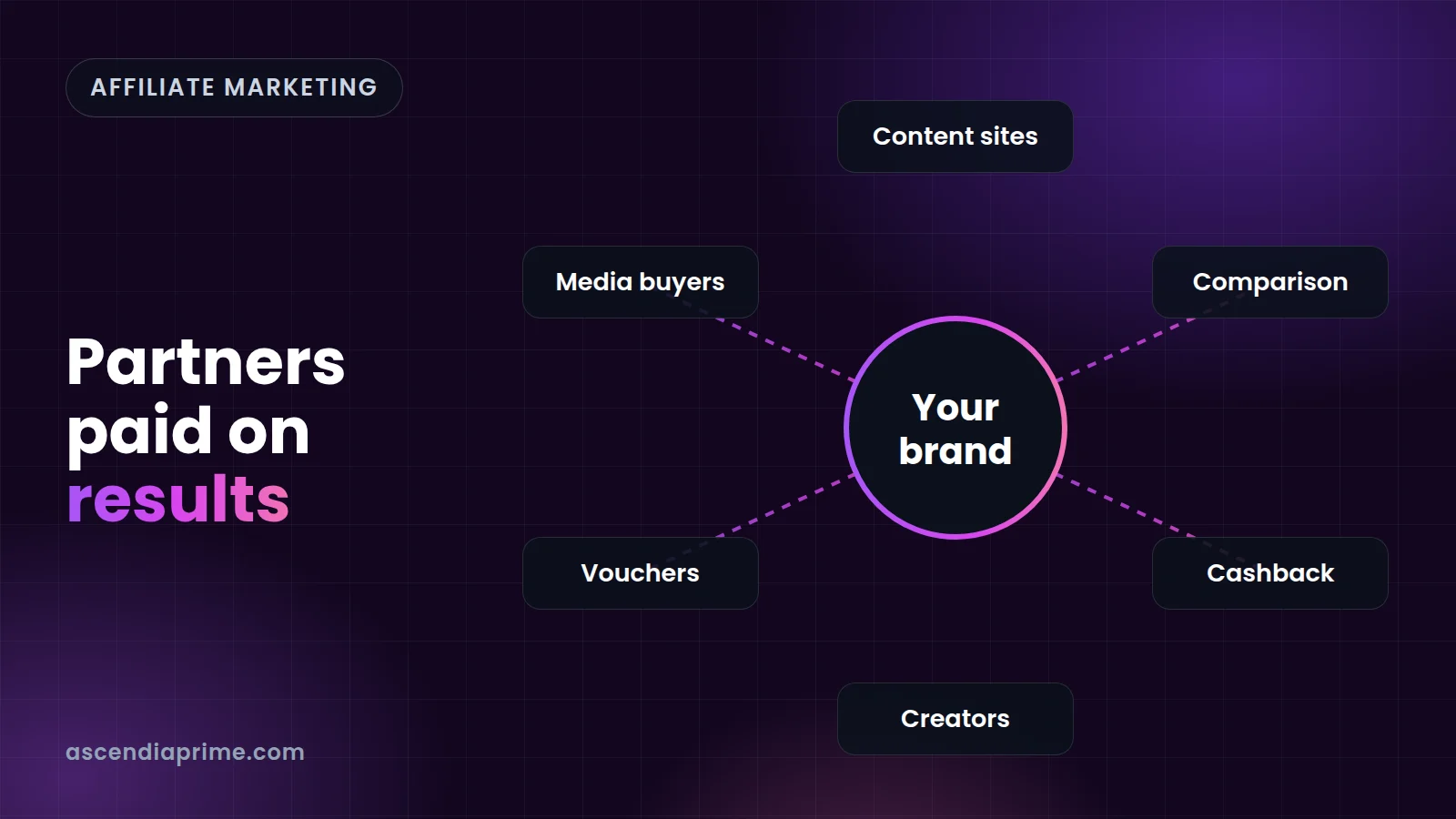
Content and review sites reach people while they're still researching, which makes them good for new customers. Comparison sites dominate in finance, insurance, utilities and travel. Cashback and loyalty sites convert extremely well, though a fair share of those buyers were already on their way to you. Voucher sites can lift conversion rates, but they need clear rules or they'll eat your margin. Creators and influencers bring trust and reach, especially in fashion, beauty and lifestyle. Sub-networks and media buyers can add real scale, but they need watching closely.
If one or two partners are driving most of your revenue, that's a risk as well as a success.
Write terms that prevent arguments
Most affiliate disputes come from terms that were never written down. At a minimum, cover whether partners can bid on your brand name in paid search, which discount codes they're allowed to use (and what happens when a code leaks), how long your attribution window is, and how you decide which channel gets credit when several were involved. Also set out how long validation takes and what counts as a cancelled or fraudulent sale.
The first few months
Early on, I'd watch four things.
The first is activation rate: of the partners you've recruited, how many actually drive sales? The second is new customer share, meaning how much of the revenue comes from people who've never bought from you before. The third is effective CPA, which is commission plus network fees plus any fixed placement costs, divided by validated sales. The fourth is return by partner, so you know who deserves more support and who should move to a lower rate.
Scaling up
Once the basics work, growth usually comes from four places. Pay more for the behaviour you want, such as new customers, content placements and partners who introduce people to your brand. Look after your top partners with exclusive offers, better placements and early access to launches. Expand into new markets once tracking and payments work internationally. And support the programme with other channels, like retargeting and programmatic media, so visitors who don't convert first time get another nudge.
Mistakes worth avoiding
A few come up again and again. Brands pay commission on customers who came through their own brand search. Discount codes leak onto sites nobody approved. Programmes get judged on revenue instead of profit and new customers. And brands recruit hundreds of publishers but support none of them.
If you'd like help
We work with a large publisher network across many markets and categories. Whether you're launching a programme or trying to get more out of an existing one, have a look at our affiliate and publisher marketing work or get in touch.