

How to Reduce Your Cost Per Acquisition: 12 Proven Tactics
27 September 2026 · Yogender Kumar, Managing Partner
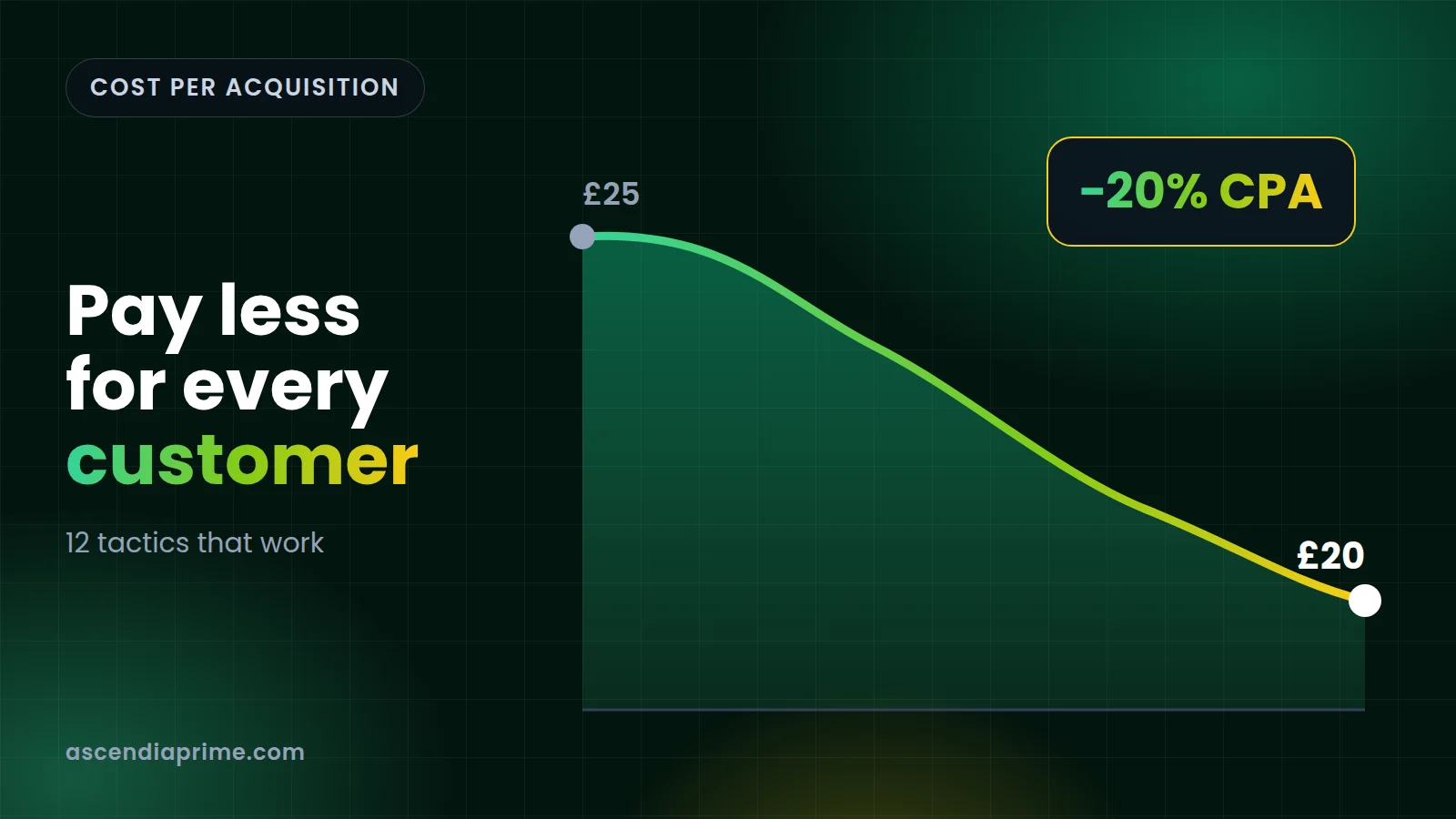
Cost per acquisition (CPA) is the simplest way to see how efficiently you're buying customers. Take your marketing spend, divide it by the number of conversions, and that's your CPA.
When it starts creeping up, profit disappears fast. The good part is that CPA is almost never driven by one thing, which means there are a lot of levers you can pull. Here are the twelve I'd look at first.
Start with what you're measuring
1. Make sure you're counting the right conversions. Duplicate tags, test orders and cancelled sales all distort the number. I've seen more "CPA problems" solved by fixing tracking than by any change to a campaign. Check that every platform counts the same validated conversions, and use server-side or first-party tracking where browsers block cookies.
2. Set your target from your own economics. Industry benchmarks are interesting, but your target should come from your margin and how much a customer is worth over time. If customers come back three times, you can afford to pay more for the first order than a business that sells once.
3. Find out what's really incremental. Some channels take credit for sales that would have happened anyway. Holdout tests and geographic tests will show you which spend is creating new customers. Cutting the rest is often the quickest CPA win there is.
Buy better traffic
4. Tighten your targeting. Remove the keywords, audiences and placements that spend without converting. In paid search that means adding negative keywords every week, not once a quarter. In programmatic it means moving budget onto lists of sites that have proven themselves.
5. Match the message to the moment. Someone searching "compare business insurance" is in a very different place from someone who's never heard of you. Group campaigns by intent and write ads for that specific person.
6. Refresh your creative before it gets tired. Ad fatigue pushes costs up quietly. Rotate in new creative before performance drops, and change one thing at a time so you know what made the difference.
7. Use retargeting, but with restraint. People who've already visited convert far more often than cold audiences. Retargeting with sensible frequency caps, and with recent buyers excluded, is usually one of the cheapest sources of conversions you have.
Convert more of the people you already have
8. Make your pages faster. Slow pages lose people before they've even seen your offer, especially on mobile. Compress images, strip out scripts you don't need, and test on a real phone rather than a fast office laptop.
9. Take friction out of forms and checkout. Every extra field and every extra step costs you customers. Ask only for what you genuinely need, offer guest checkout, and show people how close they are to finishing.
10. Put trust signals where decisions happen. Reviews, clear pricing, delivery and returns information, and a visible phone number all reduce hesitation. They work best right next to the button, not buried at the bottom of the page.
11. Keep testing your landing pages. Headlines, offers and layouts are all worth testing. Small gains compound. Lifting your conversion rate from 2% to 2.5% cuts CPA by a fifth without spending a penny more on media. There's more on this in our conversion-led growth work.

Pay for outcomes where you can
12. Move budget towards results-based channels. When you pay per sale or per lead, as you do with affiliate and publisher marketing, your CPA is fixed before you start. With good quality controls, that makes acquisition costs far more predictable.
Bringing it together
Reducing CPA isn't a one-off project. It's a cycle: measure accurately, cut the waste, convert more of the traffic you already pay for, then move budget towards what works. I'd review it monthly, not annually.
If your acquisition costs are rising and you'd like a fresh pair of eyes on them, start a conversation with us.