

What Is Performance Marketing? A Practical Guide for Growing Brands
27 September 2026 · Yogender Kumar, Managing Partner
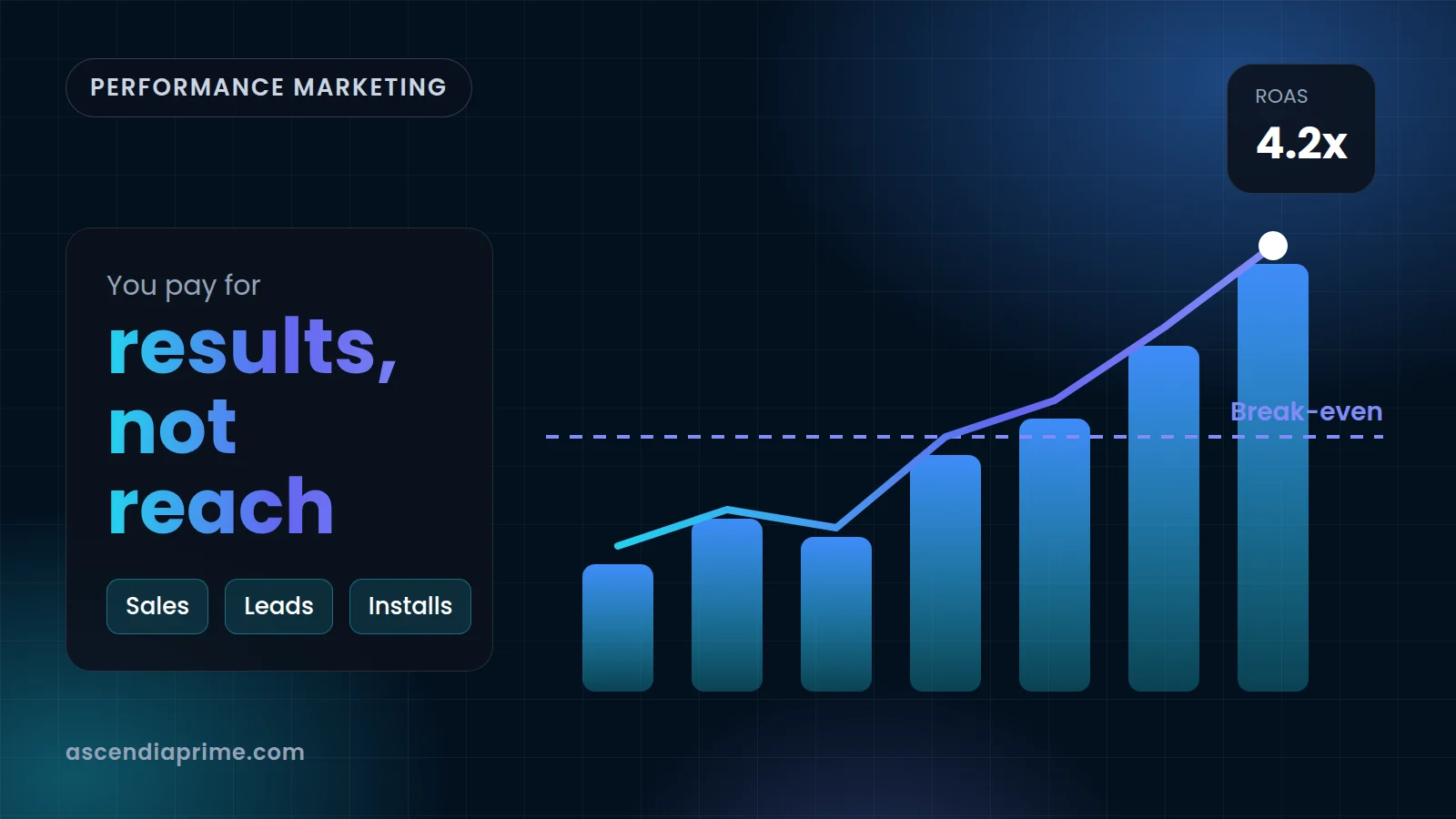
Most advertising asks you to pay first and hope later. You buy the billboard, the radio slot or the magazine page, and then you wait to see whether anything happens.
Performance marketing works the other way round. You agree up front what a result looks like, whether that's a sale, a lead, an app install or a sign-up, and you pay for that result. If nothing happens, you pay little or nothing.
That's the whole idea. The rest is detail, but the detail is where the money is made or lost, so let's go through it.
A simple definition
Performance marketing is digital marketing where you pay for, and optimise towards, a specific action rather than for impressions or airtime.
Because the goal is fixed before anything goes live, everyone involved, from the brand and the publisher to the media buyer, is pulling in the same direction. Nobody gets paid for looking busy.
How it differs from brand advertising
I don't think it's a case of one or the other. Brand advertising builds memory and trust over time, and that makes every other channel cheaper. But it's hard to measure precisely, and that's where performance marketing earns its place.
With performance marketing you decide the outcome first, set up tracking before launch, and then move money towards whatever is working, often weekly rather than quarterly. The brands that do best use both. Brand work warms people up, and performance data tells you which messages actually land.
The channels it covers
There are five channels I'd expect most growing brands to look at.
Affiliate and partner marketing. Publishers, including comparison sites, cashback sites, content creators and niche reviewers, earn a commission for each sale or lead they send. Because you only pay on results, it's usually the most cost-controlled channel you'll find. There's more on how it works on our affiliate and publisher marketing page.
Paid search and paid social. Google, Microsoft, Meta and TikTok let you reach people who are searching right now or who closely match your customer profile. You pay per click, but the campaigns should be run against conversions, not clicks. See our approach to PPC.
Programmatic media. Software and a demand-side platform (DSP) buy display, video, native and connected TV space automatically, across thousands of sites and apps. It's how you reach new audiences at scale. More on programmatic buying.
Retargeting. Showing relevant ads to people who visited but didn't buy. It's often the cheapest conversion you'll get, as long as you don't overdo it. See retargeting campaigns.
Influencer and social. Creators can be paid on performance too, with tracked links, codes and commission rather than a flat fee. See influencer marketing.
The numbers worth watching
You don't need a dashboard with forty metrics. Six will tell you nearly everything.
Cost per acquisition (CPA) is what you pay, on average, for one customer or lead. Return on ad spend (ROAS) is the revenue you get back for every pound spent, so a ROAS of 4 means £4 back for each £1. Conversion rate tells you how many visitors actually do the thing you want. Average order value tells you how much a sale is worth, which sets how much you can afford to pay for it. Lifetime value tells you what a customer is worth over months or years, and it's the number most businesses underestimate.
The sixth is the one people skip: incrementality. Would this sale have happened anyway? A channel that takes credit for customers who were already on their way to you isn't growing your business, however good its reported ROAS looks.

How you pay
Most deals fall into one of a handful of models. You can pay per sale (CPA or CPS), per qualified lead (CPL), per app install (CPI) or per click (CPC). Some premium placements use a hybrid, with a small fixed fee plus a performance element on top.
My advice is to pick the model that matches the outcome you actually care about. If you need qualified leads, don't pay for clicks and hope.
Getting started without wasting budget
Start with one goal. Brands that chase sales, leads and newsletter sign-ups all at once usually end up doing none of them well.
Fix your tracking before you spend a pound. Check that conversions fire correctly, that platforms aren't double-counting, and that consent is handled properly. It's boring work, and it saves more money than any clever bidding strategy.
Work out what you can afford to pay for a customer and still make a profit. That becomes your target CPA, and every channel gets judged against it.
Then start where intent is highest. Paid search, a well-run affiliate programme and retargeting tend to prove value fastest. Once you know what a profitable customer costs, you can widen out.
Finally, test, keep what beats the target, and cut what doesn't, without sentiment.
When it's worth bringing in help
Performance marketing rewards scale and attention: publisher relationships, buying tools, fraud checks, and someone watching the numbers every day. If your team is already stretched, a specialist partner can often reach your target CPA faster and waste less getting there.
If you'd like a second opinion on where your next customers could come from, start a conversation with us.