

Affiliate Fraud and Traffic Quality: How to Spot Bad Traffic Early
27 September 2026 · Yogender Kumar, Managing Partner
Performance marketing has a reputation for being safe. You only pay for results, so what could go wrong? Quite a lot, if nobody is checking where those results come from.
Most partners are honest and work hard for their commission. A small number aren't, and they can take a surprising share of your budget before anyone notices. This guide covers the common problems, the warning signs and the controls I'd put in place from day one.
The common types of bad traffic
Fake or low-quality leads. Forms filled with made-up details, recycled data or people who were pushed into signing up with an incentive they didn't understand. This is the biggest risk on CPL campaigns.
Cookie stuffing. A partner quietly drops their tracking cookie on people who never saw or clicked their content. When those people later buy through another route, the partner takes the commission for a sale they had nothing to do with.
Brand bidding. A partner runs paid search ads on your brand name, often against your rules. People who were already looking for you click their ad instead of your own listing, and you pay commission on a sale you'd have made anyway.
Voucher code leakage. An exclusive code meant for one audience ends up on public coupon sites. Customers who were about to buy go looking for a code, find it, and a partner gets paid for the last click.
Bots and click fraud. Automated traffic that clicks, installs or fills forms to trigger payments. It matters most on CPC and CPI campaigns.
Incentivised traffic you didn't agree to. People paid in points or rewards to complete an action. That can be fine when it's agreed and priced accordingly. It's a problem when it isn't.
The warning signs
You don't need expensive software to spot most of this. Watch for patterns that don't look like real people.

Conversion rates that are too good. A new partner converting at five times the programme average deserves a closer look before it deserves a bonus.
Sudden spikes. Genuine partners grow steadily, or spike around a campaign you know about. Overnight jumps with no explanation are a red flag.
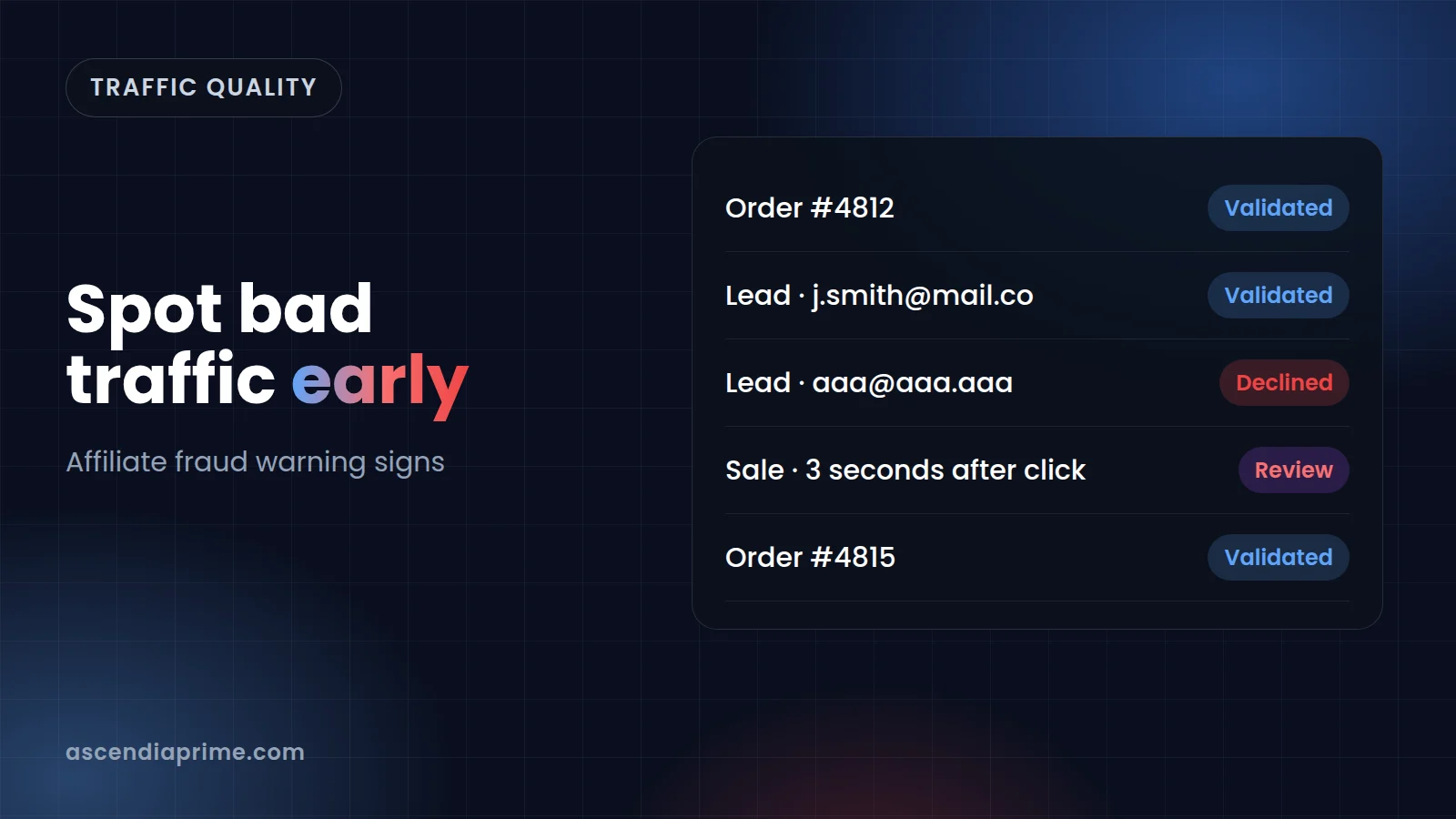
Very short click-to-sale times. A sale seconds after a click, again and again, can mean the click was injected at the last moment.
Odd timing and locations. Leads arriving at 3am from countries you don't serve, or dozens from the same device or IP address.
Duplicate or patterned details. The same phone number with one digit changed, email addresses that follow a sequence, or postcodes that don't match the town.
Poor quality after the event. High return rates, leads that never answer the phone, and customers who cancel in the first month. The front-end numbers can look fine while the back end tells the real story.
Controls to put in place from day one
1. Write clear programme terms. Spell out which traffic is allowed, including brand bidding, voucher sites, email, incentives and paid social. Say what happens if the rules are broken. Partners can't follow rules nobody has written down. There's a checklist of what to agree in our guide to choosing a pricing model.
2. Approve partners, don't auto-accept them. Look at every applicant's website or channel before approving them. If you can't see where their traffic will come from, ask.
3. Validate before you pay. Use a validation window that covers your returns or cancellation period, and decline sales and leads that don't meet your rules. Networks such as Awin, CJ, Impact and Partnerize all support this, but only if someone actually does it.
4. Check your own brand search. Search for your brand name regularly, on different devices and in different locations, and see whose ads appear. Brand monitoring tools can automate this.
5. Control your voucher codes. Use unique or single-use codes for exclusive offers, and check coupon sites for codes you didn't publish.
6. Add basic lead checks. Validate email addresses and phone numbers when the form is submitted, block obvious duplicates, and use a simple bot check. For high-value leads, a quick call-back check pays for itself.
7. Match the network's numbers to your own. Compare approved sales and leads with your own order system or CRM every month. Differences are where problems hide.
8. Review partners by quality, not just volume. Rank partners by return rates, lead-to-customer rates and customer value, not only by how many conversions they send.
When you find a problem
Start with a conversation, not an accusation. Some issues are honest mistakes, like a partner who didn't know brand bidding was off-limits or a code shared by a customer. Ask for an explanation and evidence of where the traffic came from.
If the explanation doesn't hold up, decline the affected conversions under your terms, pause the partner, and tell your network. Keep records. Clear, consistent action tells your good partners that the programme is fair, and it discourages the bad ones from coming back.
Quality is a growth strategy
It's tempting to see traffic quality as a cost of doing business. I'd argue the opposite. Clean data makes every other decision better, from which partners to reward to how much you can afford to pay. And the best publishers prefer programmes where the rules are clear and fairly applied.
Transparency and validation are built into how we run affiliate and publisher marketing at Ascendia Prime. If you're worried about the quality of the traffic you're paying for, start a conversation and we'll take a look.