

CPA vs CPL vs CPS vs CPC: How to Choose a Performance Pricing Model
27 September 2026 · Yogender Kumar, Managing Partner
When a brand first talks to us about performance marketing, one of the earliest questions is how they'll pay. Per sale? Per lead? Per click? The answer shapes everything that follows: which partners will work with you, how fast you can scale, and how much risk you're carrying.
There's no single right model. There's a right model for your margins, your sales cycle and how much you trust your own tracking. Here's how I'd think it through.
The main models in plain English
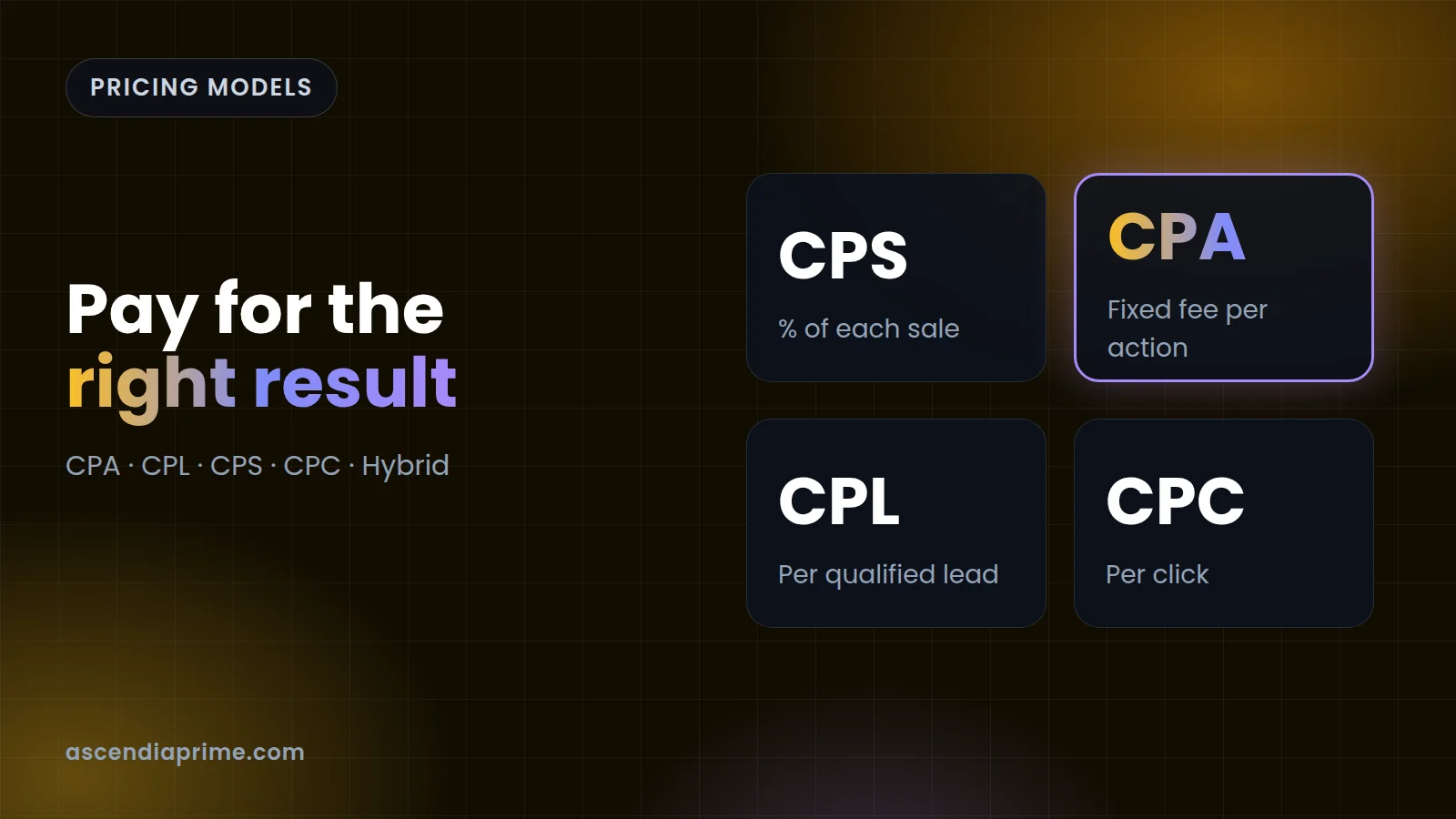
CPS (cost per sale). You pay a commission, usually a percentage of order value, when someone buys. It's the standard in retail and ecommerce affiliate programmes.
CPA (cost per acquisition). You pay a fixed amount for a defined action. Often that's a sale, but it can be a first deposit, a paid subscription or an account that passes checks. People sometimes use CPA and CPS interchangeably. The difference is that CPA is usually a flat fee, not a percentage.
CPL (cost per lead). You pay for a qualified enquiry, such as a quote request, a demo booking or a completed form. It's common in insurance, finance, education and B2B, where the sale happens later, often over the phone.
CPI (cost per install). You pay for each app install, ideally only when the user opens the app or completes a first step.
CPC (cost per click). You pay for each visit. Google and Meta mostly work this way, and so do some publishers. You carry the risk that the visitor doesn't convert.
Hybrid. A mix, for example a small fixed placement fee plus a commission, or a CPL with a bonus when the lead turns into a customer.

Who carries the risk
This is the part that's easy to miss. Every model moves risk between you and your partners.
With CPC, you pay whether or not anyone buys. With CPS or CPA, the publisher only earns when a sale comes through, so they carry the risk of traffic that doesn't convert. That's why good publishers expect higher payouts on CPS and CPA than the equivalent CPC would cost you. They're being paid for taking the risk on.
CPL sits in the middle. The publisher is paid for the enquiry, but you carry the risk that leads don't turn into customers. That's why lead quality rules matter so much with CPL.
Which model fits which business
Ecommerce with healthy margins. Start with CPS as a percentage of order value. It scales naturally with basket size, and most content, cashback and voucher sites understand it immediately.
Subscriptions and apps. A flat CPA on the first paid month, or a CPI tied to a first action, keeps things simple. If customers stay for years, you can afford a generous first payment. Just make sure you're paying for customers who stick, not free trials that cancel.
Insurance, finance, education and B2B. CPL is usually the realistic starting point, because the sale may not happen for weeks. Define exactly what a valid lead is before launch. That means complete details, the right country, no duplicates and a working phone number. Then agree how invalid leads are handled.
New brands with no conversion history. Publishers may be reluctant to take the full risk on an unknown brand. A hybrid, such as a modest fixed fee plus a commission, can get good partners to test you. Move to pure performance once you've proved the numbers.
How to set the payout
Work backwards from your own economics, not from what a competitor pays.
Start with what a customer is worth to you. For a one-off purchase, that's your margin on the order. For repeat or subscription business, it's what they'll be worth over a sensible period, such as twelve months.
Then decide what share of that value you're willing to spend to win the customer. That's your maximum CPA. Your payout to partners needs to sit comfortably below it, because there are also network fees, tools and your own time to cover.
Here's a simple example. Say an average order is £80 and your margin is 40%, so £32. If you're happy to spend half your first-order margin on acquisition, your maximum CPA is £16. A 10% commission on an £80 order is £8, which leaves room for network fees and still keeps you well inside your limit.
If you run CPL, do the same maths through your conversion rate. If one in five leads becomes a customer worth £300 in margin, each lead is worth £60 to you before costs. A £20 to £25 CPL can make sense. A £60 CPL can't.
Rules to agree before launch
Whatever model you choose, write these down and share them with every partner:
- What counts: exactly what action triggers a payment.
- Validation window: how long you have to check a sale or lead before it's approved. For retail, that should cover your returns period.
- What gets declined: cancellations, returns, duplicates, fake details, and traffic from sources you haven't allowed.
- Which traffic you allow: for example, whether partners can bid on your brand name in search, use voucher codes, send email or run paid social.
- When partners get paid: clear timings build loyalty with the publishers you most want to keep.
Clear rules protect both sides. They're also the first defence against low-quality traffic, which I cover in a separate guide on affiliate fraud.
Reviewing the model as you grow
Your first model doesn't have to be your last. Once you have a few months of data, look at which partners bring customers who stay, spend more or come back. Many brands end up with tiered commissions, paying more for new customers than returning ones, or more for high-value products. Some add bonuses for partners who hit volume targets.
If you'd like help choosing a model or checking your payouts against your margins, have a look at our affiliate and publisher marketing work or start a conversation.