

Topic: Affiliate marketing
Affiliate Network vs In-House Programme: Which Is Right for Your Brand?
30 September 2026
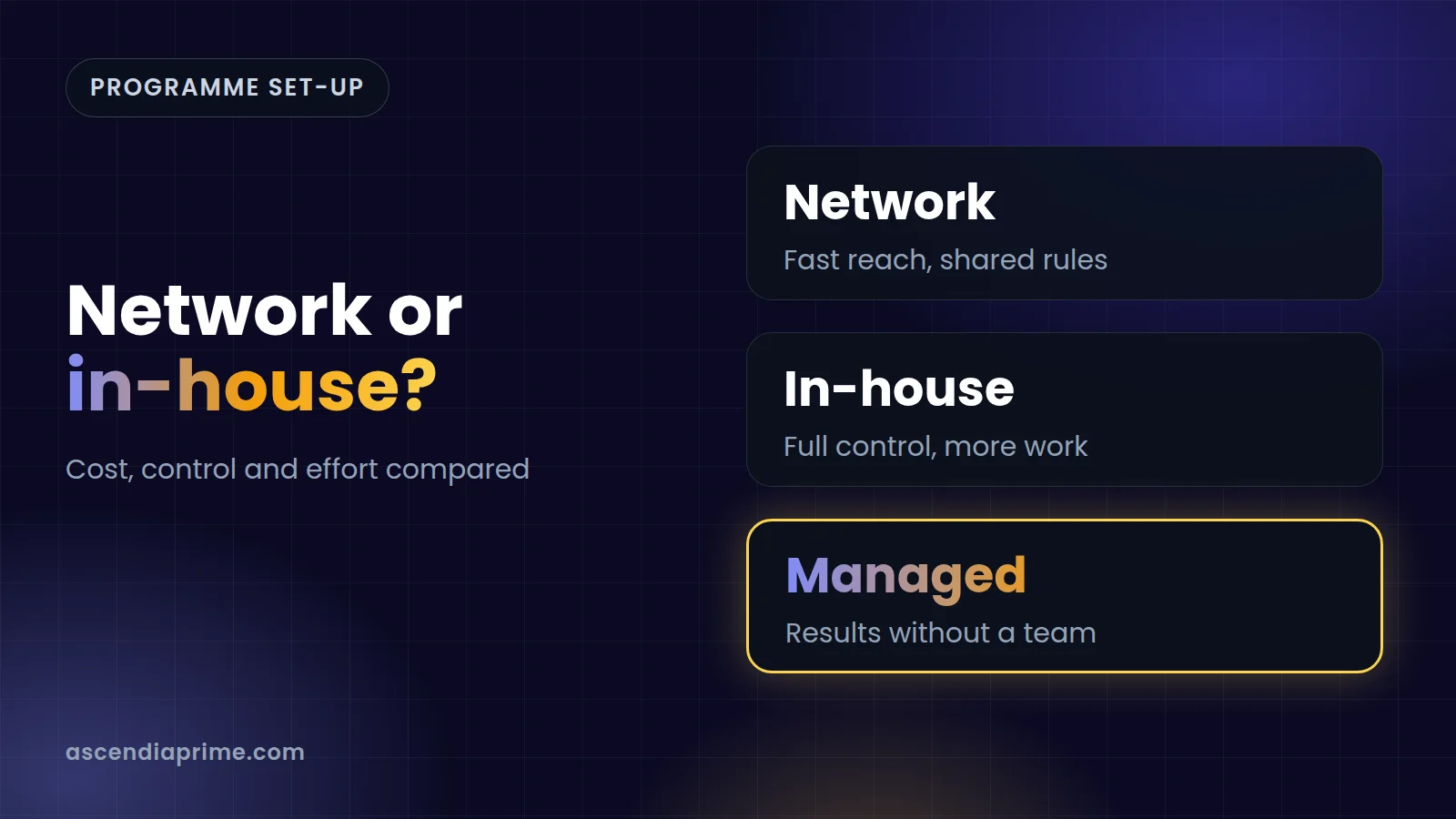
Once a brand decides to try affiliate marketing, the next question is how to run it. Join a network? Run it yourself? Hand it to someone else? I get asked this more than almost anything else, and the honest answer is that it depends on three things: how much time your team has, how much control you want, and how quickly you need results.
Here's how the main options compare.
The three main routes
An affiliate network. The network provides the tracking, the payments and access to publishers who have already joined it. You set commissions and approve partners. It's the most common starting point because publishers can find you quickly.
An in-house programme on a partnership platform. You license tracking software and run the programme yourself. You recruit every partner directly, agree terms with them and manage payments through the platform. You get more control and more of the relationship, but you do more of the work.
A managed partner. A specialist runs the programme for you, often bringing their own technology and publisher relationships. You agree the goals and the budget, and they handle recruitment, optimisation and day-to-day management.
Many brands end up with a mix, for example a network for reach plus a few direct partnerships with their most important publishers.

Speed to launch
A network is usually quickest. Publishers already on the network can join your programme as soon as it's live, so you can see first sales within weeks.
An in-house programme is slowest to build. Every partner has to be found and persuaded, which can take months before volume is meaningful.
A managed partner sits in between, or can be quicker than both if they already work with publishers in your sector.
Control and relationships
In-house gives you the most control. You own every relationship and every contract, and you can set custom terms for each partner.
With a network, you still choose who to approve and what to pay, but the network sits between you and the publishers and sets many of the rules, such as payment timings.
With a managed partner, control depends on the agreement. The best arrangements give you full visibility of every partner and conversion, so nothing important is hidden from you.
Time and skills
This is where many in-house programmes struggle. Running affiliates well means recruiting partners, answering questions, sending offers and creatives, checking traffic quality, validating sales and paying on time, every week. If that falls to someone who also runs email and paid social, it usually slips.
A network reduces some of that work, but you still need someone to manage the programme actively. A managed partner takes most of it off your plate.
Cost
Costs are easy to compare badly, so look at the total, not the headline.
- Network: commissions to partners, plus network fees. These are often a set-up fee, a monthly fee and an override, which is a percentage added on top of each commission.
- In-house: commissions, platform licence fees and the salary of whoever runs the programme. That last one is often the biggest cost and the one people forget.
- Managed: commissions, plus a management fee or a performance-based margin, depending on the model.
Work out the total cost per sale for each option at the volume you expect in year one. The cheapest-looking option on paper isn't always the cheapest in practice.
Which one fits you
Choose a network if you want to test affiliates quickly, you're in a sector well served by the network's publishers, and you have someone who can give the programme real attention.
Choose in-house if affiliates are already a major channel, you have an experienced person to run it, and you want direct relationships with a smaller number of high-value partners.
Choose a managed partner if you want results without building a team, you'd rather pay for outcomes than for software and salaries, or a previous programme stalled for lack of time.
Questions to ask whichever route you pick
- Can we see every partner, click and conversion ourselves?
- How are sales and leads validated before anyone is paid?
- What are the notice periods, and can we keep our data if we leave?
If you're weighing up a network, our checklist on how to choose an affiliate network goes into more detail.
At Ascendia Prime, clients pay CPA on validated transactions only, with no network fees and full real-time reporting, and they get a dedicated point of contact who runs the programme with them. If you'd like to talk through which route suits your brand, see our affiliate and publisher marketing page or start a conversation.