

Topic: Affiliate marketing
How to Choose an Affiliate Network in the UK: 10 Questions to Ask
30 September 2026
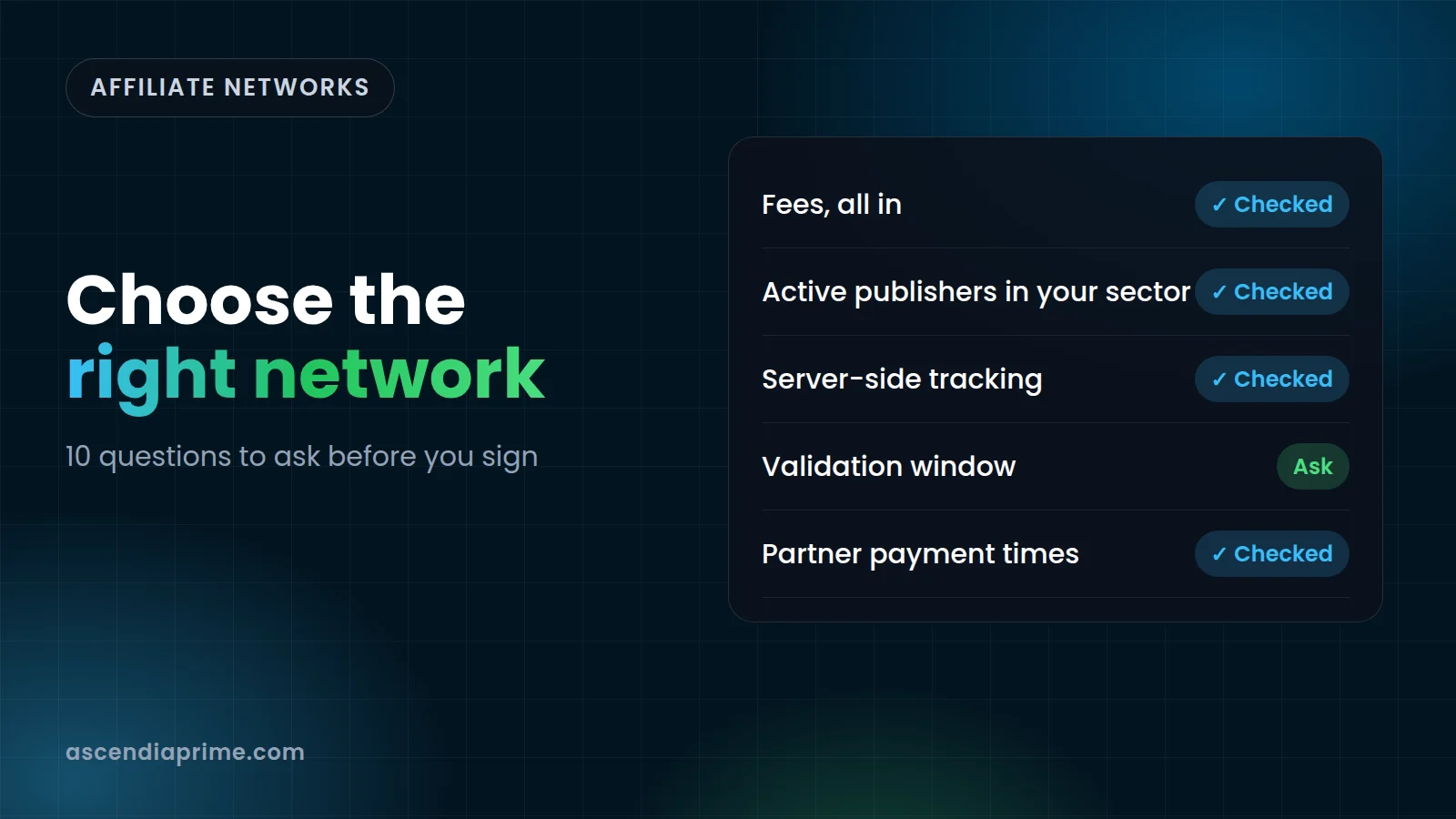
Choosing an affiliate network feels like a technical decision, but it's really a decision about who you'll be working with for the next few years. The network holds your tracking, pays your partners and shapes which publishers you can reach. Switching later is possible, but it's disruptive, so it pays to ask the right questions up front.
The UK has plenty of options, from large international networks such as Awin, CJ, Rakuten and Partnerize to smaller specialist networks and managed partners. None of them is best for everyone. Here's how I'd compare them.
Start with your own goals
Before you speak to anyone, write down three things:
- What you want to pay for. Sales, leads, app installs or sign-ups. Some networks are strongest in retail sales, others in lead generation or finance.
- What a customer is worth to you. That sets the commission you can afford, and it tells you whether the network's fees leave enough room. Our guide to choosing a pricing model walks through the maths.
- How much time you have. A self-serve network gives you tools and expects you to run the programme. A managed service does much of the work for you.
With those answers in hand, the conversations become much more useful.

The 10 questions to ask
1. What will it cost, all in? Networks usually charge some mix of a set-up fee, a monthly fee and an override, which is a percentage added on top of every commission you pay. Ask for a worked example at your expected volume, so you can compare total cost rather than headline rates.
2. Which publishers will actually promote us? Every network quotes a large number of publishers. What matters is how many are active in your sector and your country. Ask for examples of partners working with similar brands, and what share of sales come from content sites, cashback, vouchers and comparison sites.
3. How does tracking work? Ask whether they support server-to-server tracking as well as browser cookies, how they handle consent under UK GDPR, and how they deal with sales on apps and different devices. Weak tracking means missed commissions, and partners soon notice.
4. How do we validate sales and leads? You need to be able to decline returns, cancellations, duplicates and traffic that breaks your rules. Ask how long the validation window can be and how easy it is to approve or decline in bulk.
5. When do partners get paid? Publishers talk to each other. A network that pays reliably and on time makes your programme more attractive to the partners you most want.
6. Who will look after us? Find out whether you'll have a named account manager, how many other clients they handle, and whether they'll actively recruit partners for you or simply give you access to the platform.
7. What will we be able to see? Ask for a demo of the reporting. You should be able to see every click and conversion by partner, date and product, ideally in real time and exportable to your own systems.
8. How do they handle fraud and compliance? Ask what checks they run on new publishers, how they spot cookie stuffing and fake leads, and what happens when a partner breaks the rules. Our guide to affiliate fraud and traffic quality lists the warning signs to raise with them.
9. How long is the contract? Look for minimum terms, notice periods and any fees for leaving early.
10. Can we take our data and partners with us? If you ever move, you'll want your transaction history and your publisher relationships. Ask what you can export and how a handover would work.
Answers that should worry you
- Fees that are hard to pin down, or only explained after you sign.
- Publisher numbers with no detail on who is active in your sector.
- No clear process for declining invalid sales or leads.
- Slow or vague answers on when partners are paid.
- Long lock-in periods with no performance commitments in return.
None of these is a deal breaker on its own, but two or three together usually mean the relationship will be harder work than it should be.
Network, in-house or managed?
A traditional network isn't the only route. Some brands run their programme on a partnership platform with their own team, and others use a managed partner who brings both the technology and the publishers. Each has trade-offs in cost, control and time, which I cover in affiliate network vs in-house.
Run a short trial if you can
If a network is confident, it should be willing to agree clear goals for the first three to six months: how many active partners, what volume, and what level of support. Review it honestly at the end.
At Ascendia Prime, we work on CPA for validated transactions only, with no network fees or overrides and full real-time reporting, so the comparison is simple. If you'd like a second opinion on the options you're weighing up, have a look at our affiliate and publisher marketing work or start a conversation.