

Topic: Lead generation & pricing
Cost Per Lead Campaigns: How to Get Leads That Actually Convert
30 September 2026
Buying leads on a cost per lead basis looks like the safest deal in marketing. You only pay for people who have raised their hand. But anyone who has run lead generation for long knows the catch: a lead isn't a customer, and a cheap lead that never answers the phone is the most expensive kind.
This guide is about getting the part in between right, so the leads you pay for turn into revenue.
Start by defining a valid lead
Most arguments on CPL campaigns come from one missing sentence: what counts as a lead. Write it down before launch and share it with every partner. A typical definition includes:
- Complete contact details, with a working phone number and a real email address.
- The right country and region, and the right age where it matters.
- A genuine need, such as a home owner for a boiler quote, or a business of the right size for a B2B product.
- Clear consent to be contacted, recorded with the time, source and wording shown. UK GDPR and the PECR rules apply to marketing consent.
- No duplicates within a set period, such as 30 or 90 days.
Then agree how invalid leads are handled: how they're flagged, how quickly, and whether they're replaced or not paid.
Work out what a lead is worth
Your affordable CPL comes from your own numbers, not from a competitor's rate card.

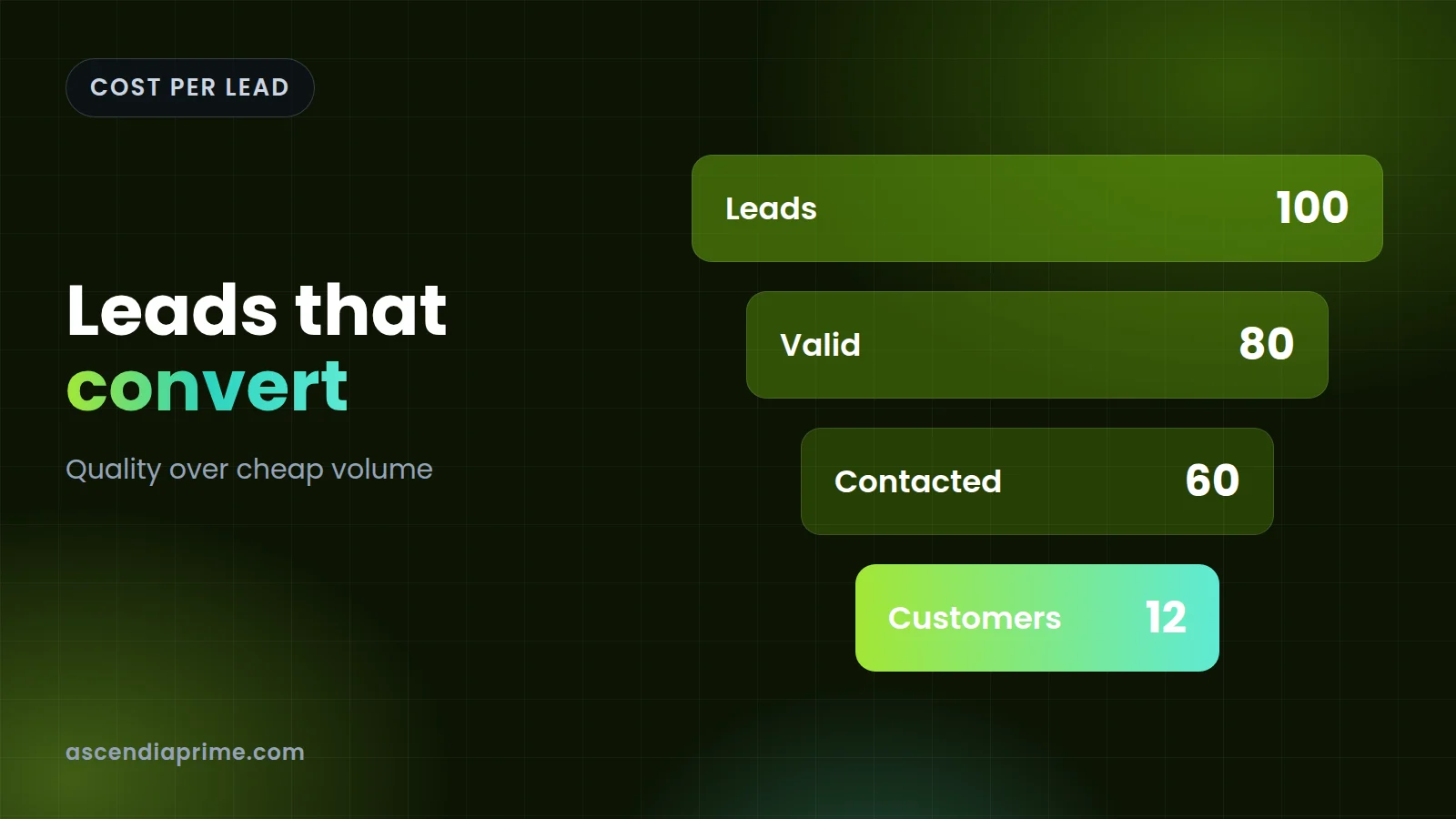
Here's a simple example. Say you buy 100 leads. After checks, 80 are valid. Your team reaches 60 of them, and 12 become customers. That's 12 customers from 100 leads.
If each customer brings in £500 of margin, those 100 leads produced £6,000. If you're willing to spend a third of that on acquisition, the leads are worth up to £2,000, or £20 each. Pay £35 a lead and you're losing money on every one, however good the volume looks.
Run the same numbers by source. Leads from different partners and channels almost always convert at very different rates, and that's where the biggest savings are.
Speed matters more than most people think
The single biggest improvement many lead buyers can make isn't in their media. It's how fast they call. A lead contacted within minutes, while the person is still thinking about the problem, is far more likely to convert than one called the next day, when they've already spoken to a competitor.
If you can't call quickly, send an immediate text or email that confirms the enquiry and says when you'll be in touch. It keeps the lead warm and reduces the "I never asked for this" responses.
Build quality into the form
A few small changes at the point of capture prevent a lot of problems later:
- Validate email addresses and phone numbers as they're typed.
- Ask one or two qualifying questions, so the lead has to engage.
- Block obvious duplicates and use a simple bot check.
- Make the consent wording clear, so people know who will contact them and why.
Every extra question will lower volume a little. That's usually a good trade when the leads you lose were never going to convert.
Close the loop with your partners
The best CPL programmes share outcomes, not just complaints. Tell partners which of their leads were contacted, which became customers and why others failed. Good partners will adjust their targeting and messaging. Partners who don't improve, or whose leads repeatedly fail, should be paid less or paused.
Once you have enough data, consider paying more for leads that turn into sales, through a higher CPL for proven sources or a bonus per customer. It aligns everyone with the result you actually want. Our guide to choosing a pricing model covers hybrid models like this.
Watch for the warning signs
Sudden volume spikes, leads arriving at odd hours, recycled or patterned details, and contact rates falling off a cliff are all signs something is wrong. We list the full set of warning signs in our guide to affiliate fraud and traffic quality.
Measure the right number
The number that matters isn't cost per lead. It's cost per customer, and ideally the value of those customers over time. A campaign with a higher CPL but twice the conversion rate is the better campaign.
If you're running lead generation and the numbers aren't adding up, look at how we approach conversion-led growth and affiliate and publisher marketing, or start a conversation.