

How We Caught 200 Invalid Leads on an £8 CPL Campaign
4 October 2026 · Yogender Kumar, Managing Partner
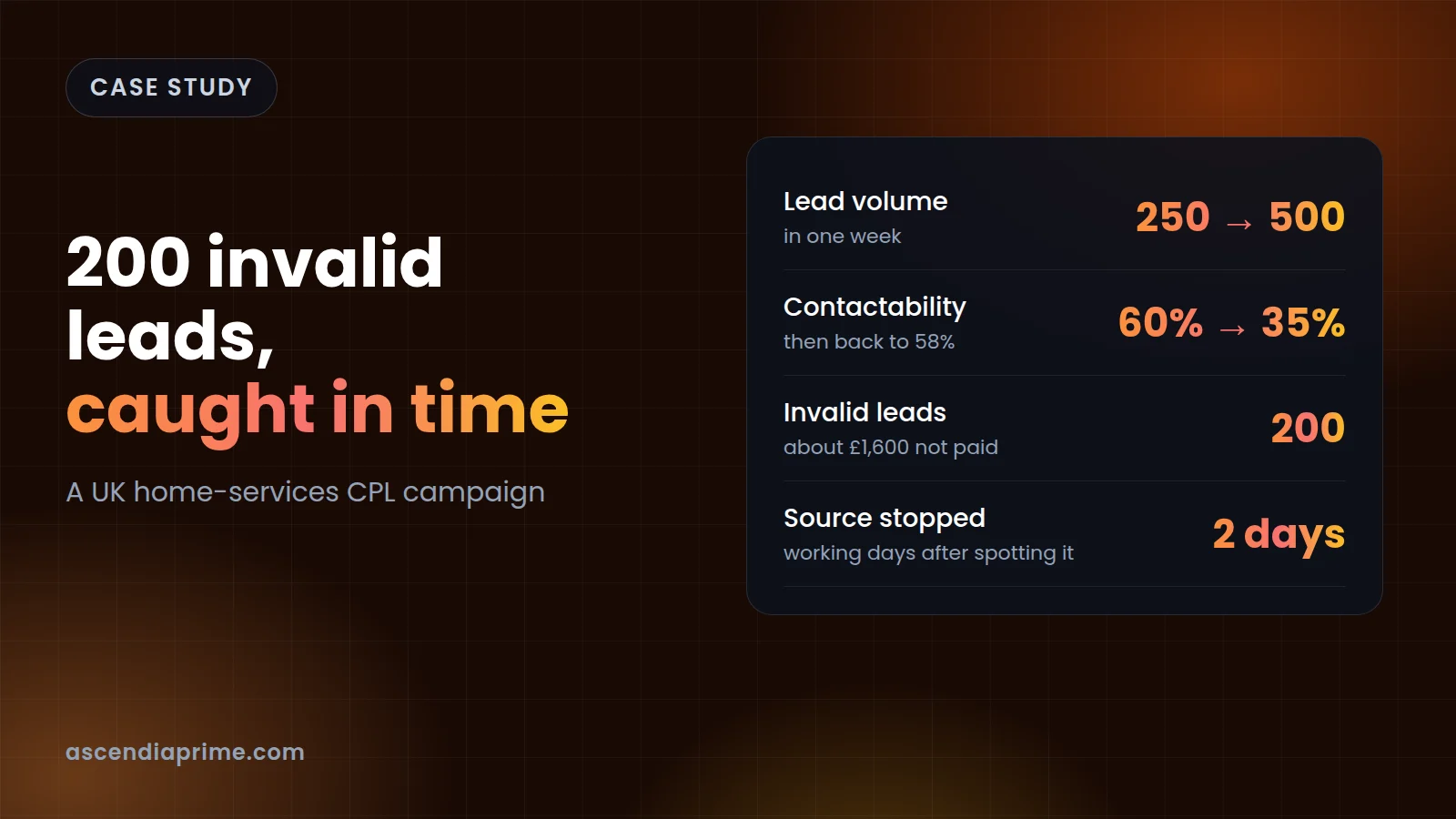
The week one publisher doubled its volume, from about 250 leads to 500, should have been a good week. The campaign was UK home services, paid at £8 a lead, and more leads normally means more business for everyone.
The advertiser's feedback said otherwise. Their call team was reaching fewer of the people we were sending. So instead of raising the publisher's cap, we stopped and looked.
Checking the drop was real
Contactability, the share of leads the call team could actually get hold of, had gone from around 60% to 35%. Before reading anything into that, I wanted to be sure we were comparing like with like. Leads that have had a few days of follow-up usually look better than brand-new ones, so we compared leads after a similar follow-up period and the same number of contact attempts.
The gap held. So the change was in the traffic, not in how we were measuring it.
Finding the source
At publisher level, all we could see was a busy week with weaker quality. The sub-publisher breakdown pointed to one sub-source.
The clearest sign was a burst of 40 submissions in six minutes from that sub-source. Its usual pattern was a few submissions spread across an hour. We checked whether a scheduled promotion or a delayed batch upload could explain it, and neither did. The burst also contained repeated contact details and enquiries from outside the advertiser's coverage area.
We didn't reject any lead for its timing alone. What made us act was the burst combined with the repeated details and out-of-area postcodes.
Two working days to stop it
On day one we checked tracking, duplicates and location eligibility, and asked the advertiser for feedback on the affected leads. On day two their first feedback backed up our concerns, so we stopped traffic from the sub-source while we finished validating.
The final count came later.
What it came to
Two hundred leads were confirmed invalid against the agreed campaign criteria. We gave each one a single main reason, so nothing was counted twice:
- 90 duplicates: repeated contact details for the same enquiry, with no valid separate request.
- 70 outside the service area: postcodes outside the advertiser's agreed coverage.
- 40 invalid contact details: confirmed through contact attempts and validation.
Sixty of the 200 had also arrived in concentrated bursts, which is what first drew our attention to the sub-source.
At £8 a lead, the 200 came to about £1,600 in payouts that were never made.
I've been careful not to call this fraud. The leads were confirmed invalid under the campaign rules. Saying every one of them was deliberately faked would need more evidence than we had, and it isn't something I'd say to a partner without it.
Restarting, slowly
We shared the findings with the publisher. They removed the sub-source and explained the checks they would add on their side.
Rather than cutting them off, we allowed a controlled restart: a cap of 25 leads a day for two weeks. Contactability came back to about 58%, close to where it was before the spike. We carried on working with them under closer monitoring, with the problem sub-source still excluded, and we added duplicate checks and tighter monitoring of new sources on our side.
When a partner co-operates like this, I prefer a capped restart to cutting them off, because the advertiser keeps the volume they were happy with.
What I'd do differently
We looked at the volume jump first and the quality data second. That was the wrong way round. When a source doubles in a week, I now ask for the advertiser's contactability and validation feedback straight away, before the conversation about raising caps even starts.
The thresholds we use
For this campaign, normal contactability was around 60%. A drop below 45%, or a fall of 15 percentage points from the usual level, triggers a review. A rate below 35% across at least 50 leads that have completed the agreed contact attempts triggers a temporary stop and an investigation.
Those are our internal operating thresholds for this campaign, not an industry standard. I'd always agree the real numbers with the advertiser, taking into account how quickly they follow up, how they contact people and the campaign's history. Clear duplicates or fabricated submissions justify action straight away, whatever the contact rate.
The checks I took from it
- Compare like with like. Same follow-up period, same number of contact attempts, before deciding quality has dropped.
- Report below publisher level. The evidence was only visible by sub-source.
- Get the advertiser's quality data weekly, and daily while any source is scaling fast.
- Stop the source quickly. We stopped it within two working days, before the final count was in.
- Restart with a cap. A daily limit for a couple of weeks shows whether the fix worked before volume returns.
- Run duplicate checks on every lead, not just after a problem.
For the wider picture, including the other kinds of bad traffic and the controls I'd set up on any programme, see our guide to affiliate fraud and traffic quality. If you'd like a second opinion on lead quality in your own programme, get in touch.