

Cutting Programmatic CPA by 15%: A Worked Haircare Ecommerce Example
15 October 2026 · Yogender Kumar, Managing Partner
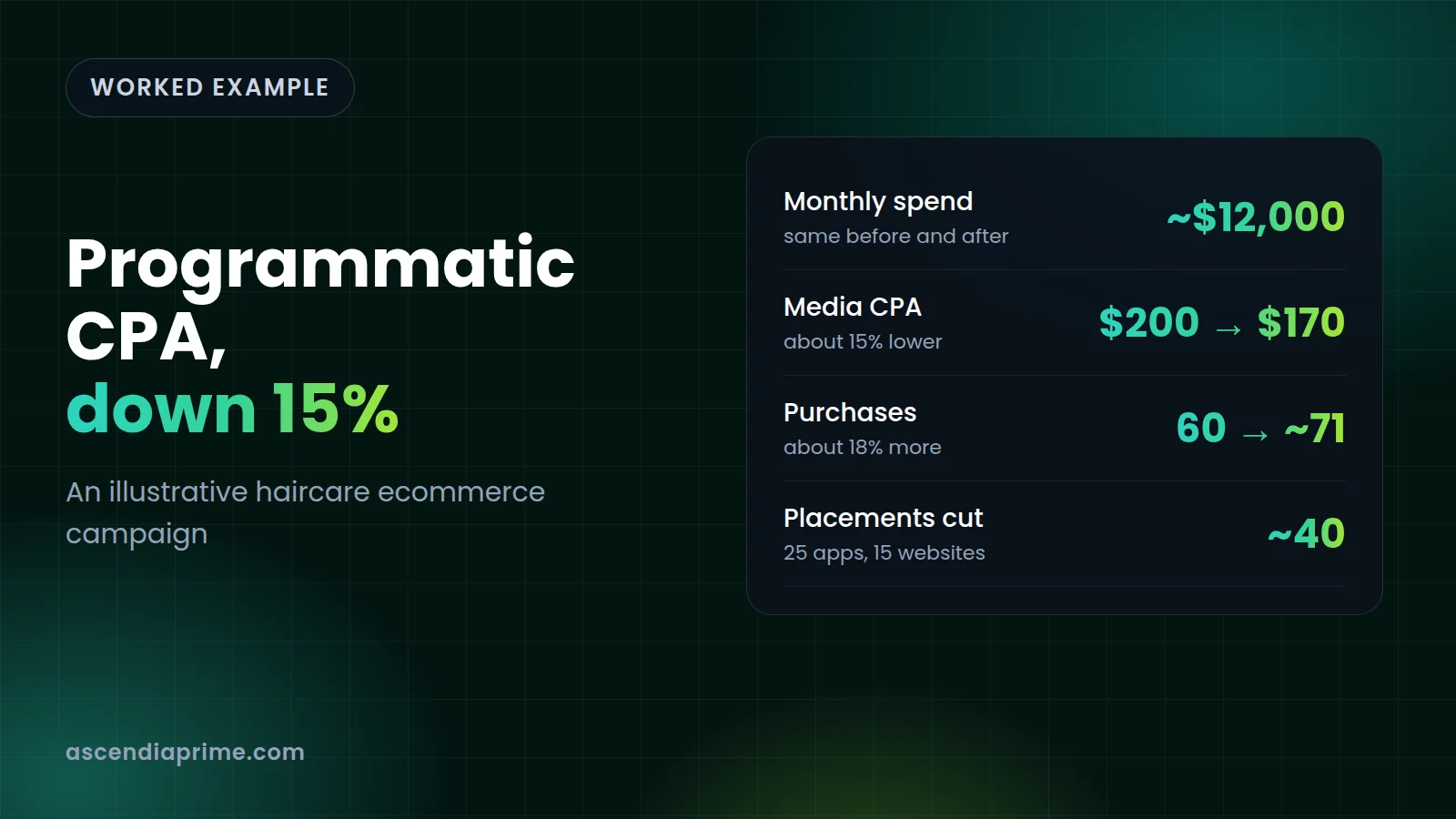
About this example: this is an illustrative scenario based on the kind of haircare ecommerce campaign we work on. The figures show how the optimisation works. They are not a reported client result.
Picture a US haircare brand selling salon-style shampoos, treatments and styling products direct to consumers. It spends around $12,000 a month on programmatic display, and it has one job for that money: online purchases at an acquisition cost it can live with.
For the first four weeks, those $12,000 bring in 60 attributed purchases. That's a media CPA of $200, and the brand wants it lower.
Here's how we'd work through it in this example, step by step.
Where the money was going
The campaign starts on a broad mix: beauty and lifestyle websites, plus general content sites and mobile apps.
On the dashboard the broad inventory looks good, because clicks are cheap. But when you line spend up against purchases, placement by placement, a lot of those cheap clicks lead nowhere. They come from people who were never close to buying.
The second leak is frequency. Some users see the ads again and again, and the extra impressions don't bring any extra purchases.
Looking at placement and device together
The tempting conclusion is "mobile is weak, cut mobile". In this example that would have been wrong.
When we split placements by device, the weak spot was narrower: certain Android app placements. Mobile web held up well, as did desktop. Cutting all mobile traffic would have thrown away some of the best inventory along with the worst.
So in this example we review placement and device in the same view rather than in two separate reports.
The four changes
After the four-week baseline, we make these changes together:
- Excluded about 40 placements: 25 apps and 15 websites with spend but little or no purchase activity.
- Moved spend onto an approved list of relevant beauty, fashion and lifestyle sites.
- Capped frequency at three impressions per user per day, where the inventory supported it.
- Lowered bids on the weaker Android app inventory, while keeping the stronger mobile-web placements.
We also review the creative so the message matched the landing page and the products it featured. Someone who clicks an ad for a curl cream shouldn't land on a page full of colour-protect shampoo.
What happened to CPA
Roughly: weeks 1 to 4 are the baseline, the changes then take four to six weeks to settle, and the remaining weeks confirm the result. Once settled, CPA averages around $170. On the same monthly budget, that's about 71 attributed purchases instead of 60.
- Monthly media spend: about $12,000 before and after.
- Attributed purchases: 60 before, about 71 after.
- Media CPA: $200 before, about $170 after.
That's roughly a 15% lower CPA and about 18% more purchases for the same spend. All figures are rounded.
Because several things change at once, I'd credit the whole set of changes, not any single one.
What the numbers don't tell you
Before calling a lower CPA a win, I'd still want to see:
- Average order value. Cheaper purchases aren't better if they're also smaller baskets.
- Returns. Returned orders reduce the real number of sales.
- New versus returning customers. Some of those purchases might have happened anyway.
- Attribution. These are attributed purchases. Proving the campaign caused them needs a holdout or a geo test.
What I'd do differently
The mistake in this example is running the first month with no placement controls, and giving too much weight to cheap clicks. Next time, I'd set placement controls from the start and review placement and device together from week one, judging each placement on whether its clicks turn into purchases at a cost the brand can afford.
A checklist you can use
- Judge placements on purchases, not clicks.
- Split by placement and device together, so you cut weak placements, not a whole device type.
- Start on an approved list. Then widen it once you know where the sales come from.
- Set a frequency cap on day one. This example uses three a day.
- Match the creative to the landing page. The ad and the page should be about the same product.
- Leave a few weeks at the end to see whether the gain holds.
For the basics of how programmatic buying and DSPs work, see our guide to programmatic advertising. If you'd like us to look at placements in your own campaigns, have a look at our DSP-led media buying or get in touch.