

What Is Programmatic Advertising and How Does a DSP Work?
27 September 2026 · Yogender Kumar, Managing Partner
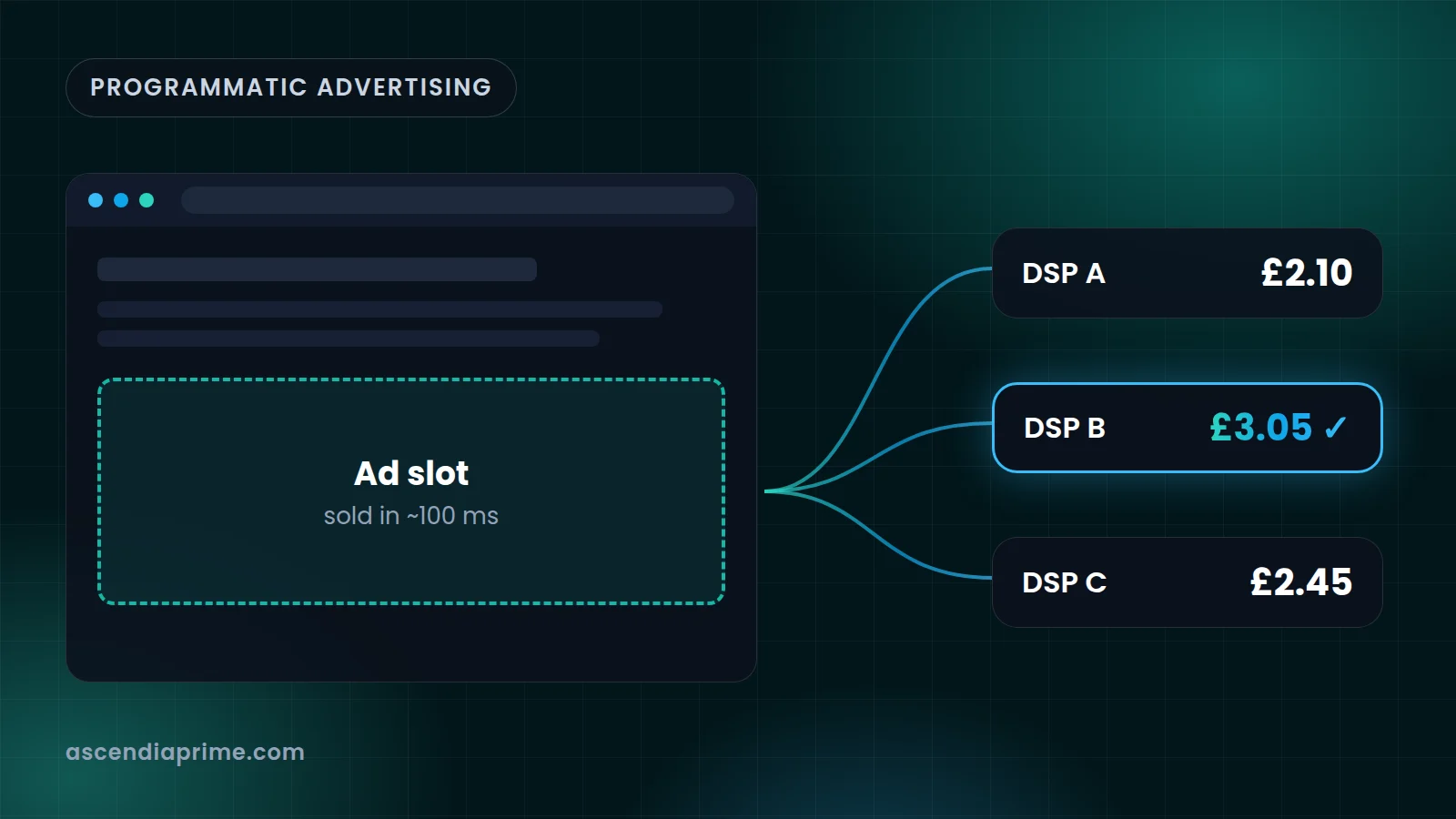
Every time a web page or app loads an ad, there's a good chance that space was bought and sold automatically, in less time than it took the page to appear. That's programmatic advertising, and it now handles most digital display, video and connected TV buying.
It sounds more complicated than it is. Here's how it works, in plain English.
What it is
Programmatic advertising is the automated buying and selling of digital ad space. Instead of phoning a publisher and agreeing a fixed placement, you set your audience, budget and bids in software, and the software buys the impressions that match.
It covers most of the formats you'd expect: display banners on sites and apps, video and native ads, connected TV and streaming, plus digital audio and digital out-of-home screens.
The main pieces
You'll hear four terms again and again.
The demand-side platform (DSP) is the buyer's tool. You load your creative, audiences and budgets into it, and it decides which impressions to bid on. The Trade Desk, Google's Display & Video 360 and Amazon DSP are well-known examples.
The supply-side platform (SSP) is the publisher's side of the same deal. It offers each ad slot to many buyers at once so the publisher gets the best price.
The ad exchange is the marketplace where the two meet and the auction happens.
Data decides who you reach. That might be your own customer data, the context of the page, or audience segments bought from third parties.
What happens in those milliseconds
Someone opens a page with an ad slot on it. The publisher's SSP sends out a request describing the slot and the context. DSPs look at it, decide whether it fits any of their campaigns, and bid. The highest eligible bid wins and the ad loads.
All of that happens before the page has finished loading. It's quite remarkable when you think about it.

Ways to buy
There are broadly three. The open auction gives you the widest reach and the most variable quality. Private marketplaces are invitation-only auctions with a selected group of premium publishers. Preferred deals and programmatic guaranteed give you fixed prices or reserved volume with specific publishers, bought through the same technology.
Most good campaigns use a mix. The open auction is for scale, and private deals are for quality.
Who you can reach
Targeting is where programmatic really earns its keep. You can reach your own customers and site visitors, or place ads next to relevant content without relying on personal data at all. You can use interest and behaviour segments, or find new people who look like your best customers. On top of that you can control geography, device, time of day and how often the same person sees your ad.
In a world with fewer cookies, I'd pay particular attention to contextual targeting and your own first-party data. Both are getting more valuable, not less.
What it costs
Programmatic media is usually priced per thousand impressions (CPM), and prices vary a lot depending on format, audience and quality. Connected TV and premium video cost more than standard display.
Two things to watch. First, include platform, data and verification fees when you compare costs, because they add up. Second, judge the campaign on outcomes such as cost per acquisition, not on CPM. Cheap impressions that nobody sees are expensive.
Keeping it safe and efficient
Use inclusion lists of approved sites rather than relying only on block lists. Use verification tools to check viewability, invalid traffic and brand safety. Set sensible frequency caps, because showing someone the same ad fifteen times helps nobody. Prefer supply paths that go direct to the publisher, since every extra hop takes a fee. And measure with proper incrementality tests rather than taking view-through conversions at face value.
Is it right for you?
Programmatic works best when you know who you want to reach, have creative worth looking at, and can measure results beyond the click. It's especially good for finding new audiences at scale and for retargeting people who already know you.
If you'd like to see how it could fit your plans, read about our programmatic media buying or talk to us.